
A Beginner’s Guide to Drone Surveying
- Anvita Shrivastava

- Mar 9
- 5 min read
Land surveying has evolved significantly over the last decade. Traditional surveying methods that once required days or weeks of fieldwork can now be completed much faster using unmanned aerial technology. Drone land surveying is transforming industries such as construction, mining, agriculture, and infrastructure development by providing accurate, high-resolution data in a fraction of the time.

What Is Drone Land Surveying?
Drone land surveying is the collection of aerial data using UAVs, or drones, which are programmed to fly over designated areas and collect data through the use of cameras or sensors for mapping and measuring purposes.
When using drones for surveying, high-resolution images or LiDAR data are captured while flying over an area according to a pre-programmed flight path.
After capturing all of the images, the data is processed using photogrammetry software to produce accurate representations (maps, orthomosaics, and 3D models) of the land that has been surveyed.
Examples of applications where drone surveying is commonly used:
Topographic surveys
Monitoring of construction sites
Calculation of mining volumes
Planning for land development
Inspection of infrastructure
Analysis in agriculture
Drones are able to collect thousands of overlapping aerial images much more quickly than using traditional methods of obtaining geospatial data.
How Drone Land Surveying Works
Typically, drone land surveying is performed by following a structured workflow in order to obtain data that is accurate and reliable.
Mission Planning
Before a drone launches into the air, a surveyor must plan out their mission using special software designed specifically for flight planning. This involves identifying the survey area, noting important parameters such as altitude, overlap, and flight Path.
Important factors to be considered when planning a mission are as follows:
Ground Sampling Distance (GSD), which refers to the space between images on the ground.
Overlap of images (typically 70% to 80%)
Altitude during flight
Weather Conditions
By carefully planning out the mission of the drone in this manner, it will ensure that the data collected will be sufficiently accurate for the requirements of the project.
Ground Control Points (GCP’s)
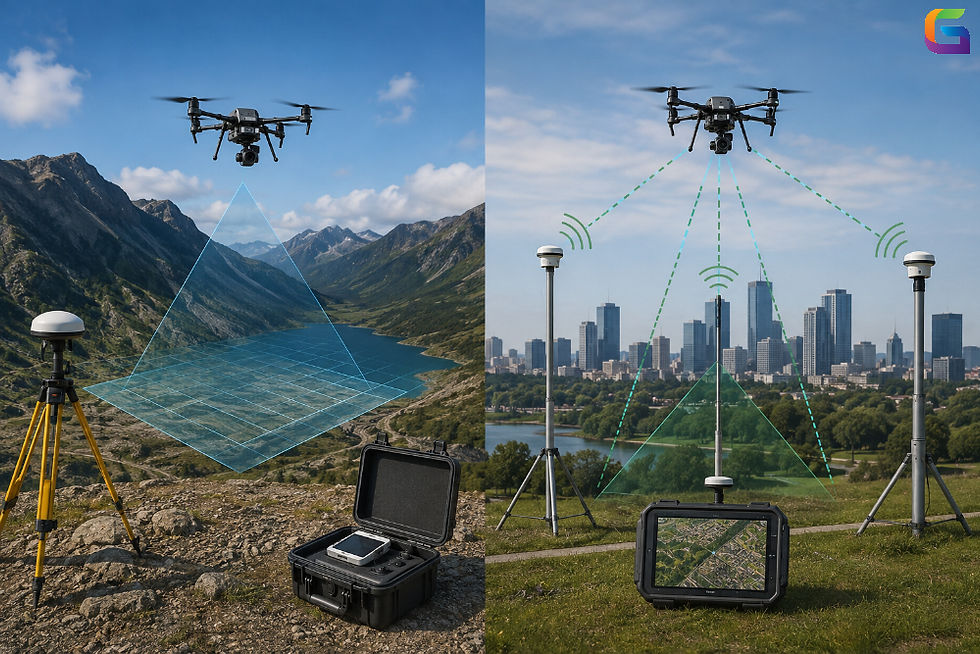
Ground Control Points (GCP’s) are markers that are placed on the ground at an exact location with known coordinates. These coordinate locations are established using GPS or RTK GNSS (Real Time Kinematic Global Navigation Satellite Systems).
The use of Ground Control Points (GCP’s) increases the positional accuracy of drone data because they assist photogrammetry software (software used to reconstruct 3-dimensional areas from the data collected by aerial images taken from drones) in aligning drone images with known coordinate data from the world.
Data Capture
Once everything has been prepared, the drone can autonomously complete the flight path that was previously planned by taking images at different intervals.
Typical types of sensors that are used on drones are as follows:
RGB Camera
LiDAR Sensor
Multi-Spectral Camera
Each image taken by these sensors has an overlap with adjacent images, which allows the software to re-create a three-dimensional representation of the geographical area being photographed using drone data.
Processing Data
Once the flight completes, the image data is put into the photogrammetry program and processed into a series of deliverables, including:
Orthomosaic maps
3D Point Cloud
Depending on the amount of data being dealt with, processing may take anywhere from a few minutes to several hours.
Analysis of Data and Deliverables
Surveyors will then analyze the processed data for measurement and insight. The deliverables of data analysis may consist of:
Topographic maps
Elevation models
Volume calculations
Construction progress reporting
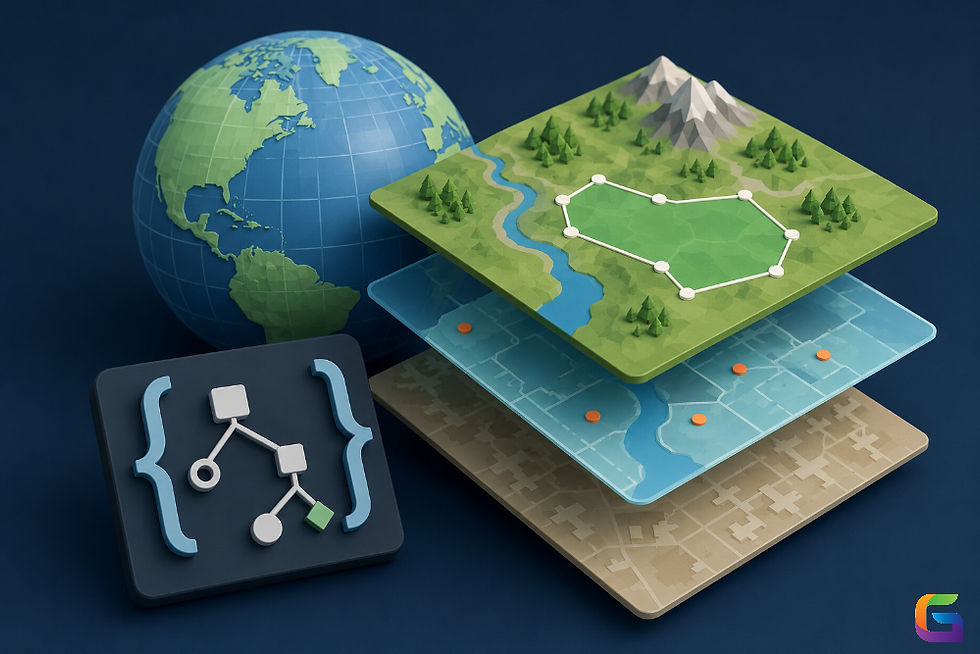
These datasets may also be combined with GIS or CAD applications for continued analysis and project planning.
Equipment Required for Drone Surveying
For efficient drone land surveying, it is necessary to have the following types of equipment:
Survey Drones
Professional mapping drones typically utilize high-precision position systems (RTK or PPK) for improved accuracy.
Sensors and Cameras
High-resolution cameras are the most commonly used sensors in drone surveying; however, some projects may also require specialized sensors (for example, LiDAR) to accurately map dense vegetation or complex terrain.
Ground Control Equipment
GNSS receivers of survey grade are used to accurately determine the position of Ground Control Points.
Photogrammetry Software
Aerial imagery is processed to produce usable mapping products using a photogrammetry software platform. The types of outputs typically produced include orthomosaic maps, elevation models, and 3D reconstructions.
Benefits of Drone Land Surveying
Drone surveying offers numerous advantages compared to traditional surveying techniques.
Faster Data Collection
Drones can survey large areas in a fraction of the time required for ground surveys.
High Accuracy
With RTK/PPK systems and proper ground control, drone surveys can achieve centimeter-level accuracy.
Cost Efficiency
Reduced field time and fewer personnel requirements make drone surveys more cost-effective for many projects.
Improved Safety
Drones allow surveyors to collect data from dangerous or inaccessible areas without putting personnel at risk.
High-Resolution Data
Drone imagery provides detailed visual data that can be used for analysis, monitoring, and documentation.
Industries Using Drone Surveying
Drone land surveying is used across numerous sectors, such as:
Construction and Infrastructure
Mining and Quarrying
Agriculture and Precision Farming
Oil and Gas
Environmental Monitoring
Urban Planning
Drone technology is rapidly changing in terms of capabilities; therefore, the number of uses for surveying purposes will continue to grow.
Challenges and Considerations
Some considerations must be considered with the benefits of using drones for survey work.
Remote Regulations
There are regulations in the Common Aviation Safety Regulations (CASR) related to all aspects of drone use that must be complied with.
Weather Conditions
Weather conditions such as wind, rain, and light will impact both the performance of a drone during its operation and the quality of the information that can be measured.
Data Processing Requirements
There is a high demand for very large amounts of data captured by drones that will need extensive amounts of computer power or dedicated software to process.
Future of Surveying with Drones
The innovations surrounding surveying with drones are evolving rapidly. Some examples of the changes include the development of software for automatically processing data captured by drones through artificial intelligence-powered mapping, the use of more advanced LiDAR sensors for measuring areas on the earth's surface, and improvements in processing times associated with using drones for collecting data.
Professionals wishing to enter the field of surveying can use the knowledge of drones and drone technology as a means to gain a competitive advantage over other survey professionals.
The emergence of drone technology has dramatically altered how experts gather and examine geospatial data, including the use of UAVs and photogrammetry combined with GNSS positioning systems to create highly accurate and timely maps and models.
For those new to drone surveying, it is essential to understand the basic workflow, equipment, and advantages associated with drone surveying; this will ultimately help you take advantage of this cutting-edge technology.
As the use of drones increases, they will become increasingly prevalent in contemporary land surveying and mapping applications.
For more information or any questions regarding the drone surveys, please don't hesitate to contact us at:
Email:
USA (HQ): (720) 702–4849

Comments