
Drone Sensor Types: RGB vs Multispectral, Thermal & LiDAR
- Anvita Shrivastava

- Dec 1, 2025
- 4 min read
Updated: 6 days ago
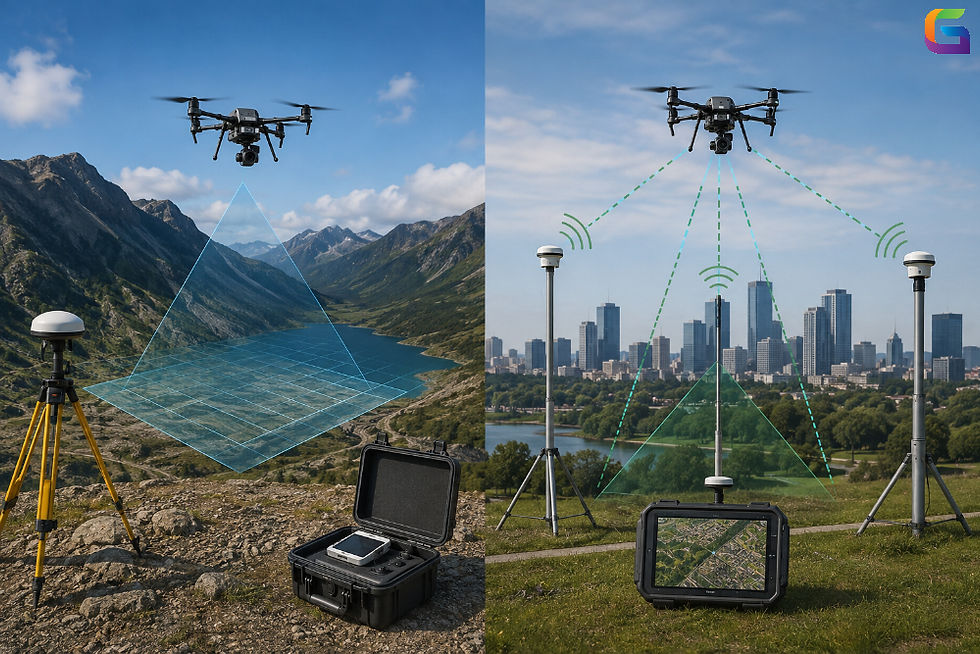
Drones have changed the way industries perform operations and tasks like agriculture, construction, monitoring the environment, and providing public safety etc. Realising an actionable insight from the data collected by a drone depends primarily on the type of sensor your drone is equipped with. The choice of the right sensor has a significant impact on the quality of data acquired, how deeply the data analysis will be able to penetrate, and therefore will determine the overall efficiency of drone operations. In the following article, we will break down the most commonly used sensors, RGB, Multispectral, Thermal, and LiDAR, to help ensure you make the best decision for your specific needs.

An Overview of RGB Sensors and Aerial Imaging
RGB Sensors are one of the most popular and commonly used types of drone cameras. They provide images that exist in the three visible light spectrum colours of Red, Green, and Blue. RGB Sensors function in much the same way as a smartphone camera, but are specifically designed to capture images using the aerial imaging process.
Key Uses and Applications
Uses and applications of RGB Sensors include, but are not limited to:
Mapping & Surveying
Monitoring Construction Sites
Real Estate Photography
Checking the Integrity of the Infrastructure
Benefits
High-resolution imagery for detailed visual analysis
Cost-effective and widely available
Easy to integrate with photogrammetry software for 3D modeling
Limitations
RGB Sensors do not help in assessing vegetation health, identifying temperature differences, or determining material composition.
RGB Sensors can provide the highest quality results when photographing in well-lit conditions.
Multispectral Sensors: Unlocking Data Beyond the Visible Spectrum
Multispectral sensors capture light from specific bands outside the visible spectrum, including Near-Infrared (NIR). This allows for detailed analysis of vegetation health, soil properties, and water content.
Multispectral Sensor Applications Include:
Precision agriculture
Environmental monitoring
Forestry management
Water resource management
Advantages of Using Multispectral Sensors Include:
The ability to calculate NDVI (Normalized Difference Vegetation Index) for crop health
The ability to identify plant stress before visual indicators are present
Providing decision makers with improved resource management and yield forecasting
Disadvantages of Using Multispectral Sensors Include:
Higher initial cost when compared to RGB cameras
The a need for advanced data processing and analysis software in addition to specialized training for data analysis.
Thermal Sensors: Seeing Heat to Reveal Hidden Patterns
A thermal sensor measures infrared radiation produced by an object and converts this into a visual image of the heat pattern emitted by that object. Thermal sensors are especially effective in applications where temperature differences are important.
The following are eight typical use cases for thermal sensors:
Search and rescue operations
Monitoring and firefighting hotspot areas
Energy audits of buildings
Monitoring the wildlife population
Advantages:
Thermal sensors can detect heat patterns that cannot be seen with the naked eye.
Thermal sensors can be used in low levels of light or at night.
Thermal sensors provide an increased level of safety by identifying potential danger or hazard areas.
Limitation:
Thermal sensors do not provide the same level of spatial resolution as RGB sensors or LiDAR sensors.
The readings from thermal sensors can be impacted by environmental factors such as wind and humidity.
LiDAR Sensors: Precision Mapping with Laser Technology
LiDAR sensors use lasers to measure distances and, consequently, provide highly accurate 3D representations of the environment. LiDAR works differently from traditional cameras in that the laser pulse measures how long it takes for the laser pulse to reflect off an object.
The following are the most typical use cases for LiDAR sensors:
Topographic mapping and modeling of terrain
Analysis of land use, forestry, and vegetative growth
Planning of construction and infrastructure development
Flood risk assessment and disaster planning
Advantages:
LiDAR will provide accurate 3D measurements in any lighting condition.
LiDAR is capable of penetrating through vegetation to provide a detailed representation of the terrain underneath the vegetation.
LiDAR provides superior, detailed representations of large geographic areas.
Limitations:
LiDAR is a very expensive system to use and is very complex.
There is a requirement for specialized software and expertise to process the data collected with LiDAR.
Choosing the Right Sensor for Your Drone
Selecting the right sensor depends on your project goals, budget, and data requirements. Here's a quick decision guide:
Sensor Type | Best For | Pros | Cons |
RGB | General aerial photography & mapping | Affordable, high-resolution | Limited analytical capabilities |
Multispectral | Agriculture & environmental monitoring | Early detection of stress, actionable data | Expensive, complex analysis |
Thermal | Search & rescue, energy audits | Detects heat signatures, works at night | Lower resolution, affected by the environment |
LiDAR | 3D mapping & topography | Highly accurate 3D models penetrate vegetation. | Very expensive, complex data processing |
Understanding the differences between RGB, Multispectral, Thermal, and LiDAR sensors is essential for maximizing the potential of drone technology. While RGB cameras are ideal for basic aerial imaging, specialized sensors like Multispectral, Thermal, and LiDAR provide insights that go beyond visual observation. By aligning your sensor choice with your project goals, you can unlock richer, more actionable data and drive better decision-making.
For more information or any questions regarding the drone sensor, please don't hesitate to contact us at:
Email:
USA (HQ): (720) 702–4849

Comments